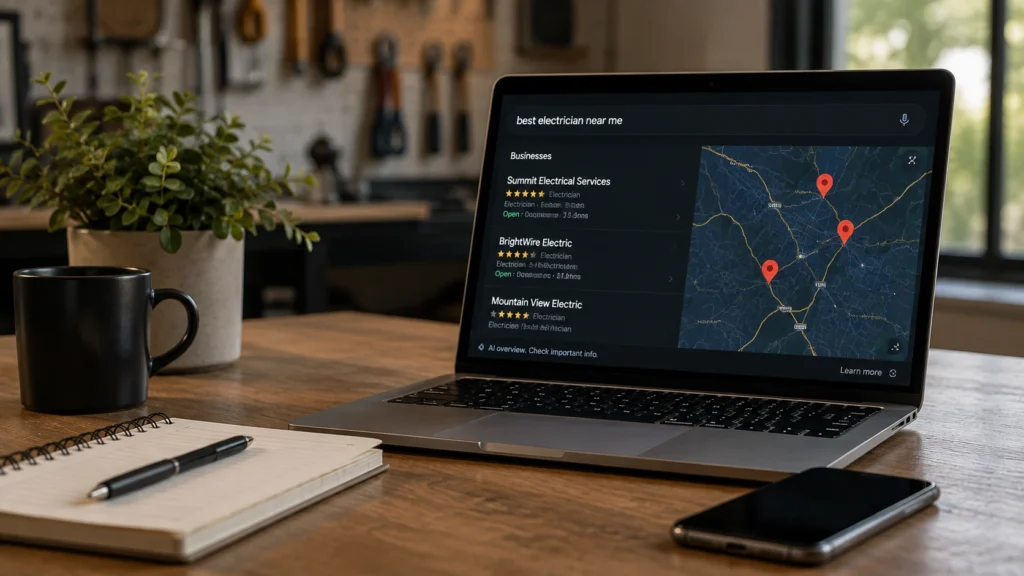

Answer Engine Optimization structures your content so AI systems can extract your business as the direct response to a local query. When someone asks a voice assistant or AI chat tool which plumber, electrician, or contractor to call, the business that gets named is the one whose content was formatted to answer that exact question directly, not the one with the most backlinks.
Key Takeaways
- AEO is about getting your content extracted as the actual answer inside AI-generated responses, not just appearing on a results page.
- Local service pages need to open with a direct, specific answer sentence to be cited by AI systems.
- Schema markup labels your content so AI systems can read it without guessing at what your business does or where you operate.
- Voice and AI chat queries are phrased as complete questions, and your content needs to mirror that format to be pulled into responses.
- Waiting to implement AEO isn’t a neutral position. Every week a competitor’s answer fills that space is qualified traffic you didn’t receive.
What Is AEO and Why Does It Matter More Than Traditional SEO Right Now?
Traditional SEO optimized for a specific position on a list of results. AEO optimizes for something different: getting your content cited as the actual answer, so the results list never appears at all.
When someone asks their phone “who’s the best HVAC company near me with same-day service,” they’re not scrolling through blue links. They’re receiving a synthesized response from an AI system that pulled content from a source it considered structured and trustworthy. If your business isn’t that source, you don’t exist in that moment. Not in second place. Absent.
The reason most local businesses are invisible in AI search isn’t that their service is worse than a competitor’s. It’s that their content is formatted for a crawl-and-rank system, not for the extraction model AI tools use. AI language models identify question-answer patterns in content and pull from pages that mirror those patterns. A page structured as a brand narrative gets skipped. A page structured as a direct answer to a concrete question gets cited.
This distinction is worth understanding carefully if you’ve assumed your current SEO work covers AI visibility. It doesn’t. They’re different systems with different inputs, and optimizing for one doesn’t automatically serve the other.
Why Does AI Keep Skipping Your Local Business?
AI systems don’t reward vague content. They reward specific, structured, directly answerable content.
When an AI engine processes a local query, it scans for content that matches the question format, contains a clear answer near the top, includes supporting context like location and service type, and is marked up in a way the system can parse without inference.
Consider a typical scenario. A local plumbing company has a well-built website, strong reviews, and solid backlinks. But every service page opens with a paragraph about being “a trusted local business serving the community for over a decade.” That sentence answers nothing. It names no location precisely, no service specifically, and no question at all.
A competitor’s site is simpler and less polished, but each service page opens with: “Cascade Plumbing handles emergency pipe repairs in Kelowna with same-day appointments available seven days a week.” That sentence answers what, where, and when in one sentence. The AI cites the simpler site. The well-designed one doesn’t appear.
That’s not a fluke. It’s the mechanism working as designed. AI retrieval systems are pattern-matching to question-answer structure, and only one of those sites provides it. If you want to understand how this plays out specifically for service professionals in competitive local markets, the AEO guide for local businesses generating leads covers the strategic framing in detail.
What Does AEO-Optimized Content Actually Look Like?
Here’s the operational structure most general guides aren’t specific enough to explain.
Every core service page should open with a direct answer sentence. Not a headline that names the service, and not a paragraph about your founding story. It should answer the most likely question a local prospect would ask about that service in your city, specifically.
From there, the page moves through natural follow-up questions: How fast can you respond?
What does it cost? What credentials do you hold? What’s the process to start? Each of those questions becomes an H2 or H3 subheading, and each answer is two to four sentences, self-contained. A reader who only reads one section should still walk away with a complete, usable answer.
This isn’t just good writing structure. The causal mechanism is that AI systems were trained on question-and-answer datasets. Content that mirrors that format has a meaningfully higher probability of being extracted than content organized around brand storytelling or keyword density. You’re writing in the format the system was trained to recognize as authoritative.
The second layer is schema markup. LocalBusiness schema tells search systems your business name, address, phone number, service area, hours, and category in a format they can read without interpreting. FAQPage schema marks your question-and-answer pairs as machine-readable. Without schema, an AI system has to infer what your business does and where it operates. With schema, you’ve handed it a labeled map.
For a practical look at how this applies to voice and near-me searches specifically, the AEO coverage for local near-me and voice searches walks through the schema implementation step by step.
The AEO Visibility Scorecard: Find Where You’re Losing Citations
Use this five-point framework to identify exactly where your content is failing to get extracted before you spend time rewriting anything. Score each item as 0 (not present), 1 (partially implemented), or 2 (fully in place).
| Signal | What to Check | Max Score |
|---|---|---|
| Direct Answer Openers | Do service pages open with a specific answer sentence? | 2 |
| Question-Based Subheadings | Are FAQs formatted as H2/H3 questions with direct answers? | 2 |
| LocalBusiness Schema | Is structured data implemented with complete name, address, phone, and service area? | 2 |
| FAQPage Schema | Are FAQ sections marked up for machine parsing? | 2 |
| Conversational Query Match | Does your content use the phrasing a voice searcher would actually use? | 2 |
A score of 8 to 10 means your content is structurally positioned for AI citation. A score below 6 means AI systems are likely skipping your pages even when your answer is technically correct, simply because the format doesn’t signal extractability. This scorecard takes less than an hour to run across your five most important service pages. The result is a concrete action list, not a vague recommendation to “create better content.”
Isn’t Google Ranking Still Enough for Local Visibility?
This is the assumption worth pressing on directly.
Ranking on page one of Google was sufficient when page one was where queries resolved. In a growing portion of local searches, the AI Overview or voice response resolves the query before the results list appears. Page one results show up beneath it, or not at all.
The businesses that appear in those AI responses aren’t always the ones with the strongest domain authority or the most backlinks. They’re the ones whose content is structured for extraction. A newer local business with precisely formatted AEO content can get cited ahead of a competitor with years of SEO investment, because the AI is prioritizing extractability over authority signals. A precise, directly answerable response from a less-established domain beats a vague, brand-narrative page from a dominant one.
There’s a second assumption worth challenging. Many local business owners believe a fully optimized Google Business Profile handles their AI visibility. It handles map pack and local pack rankings. It does very little for AI-generated answer citations. Those are different systems pulling from different inputs, and treating them as interchangeable leaves a significant gap in your local visibility strategy.
If you want to understand the specific mechanics of getting cited in AI chat tools, the step-by-step walkthrough on ranking in ChatGPT as a local business is worth reading alongside this piece. And for a sharp look at how this visibility gap is playing out in one specific competitive local market, the analysis of why real estate agents are becoming invisible in AI search makes the stakes concrete.
What Realistic Results Should You Expect?
AEO isn’t a setting you toggle. It’s a structural change to how your content communicates with AI retrieval systems.
When a local business rewrites its core service pages using direct-answer formatting and adds schema markup, it typically starts seeing citations in AI responses for lower-competition local queries first, such as voice searches and AI Overview appearances. Higher-intent queries in competitive markets take longer, partly because systems like ChatGPT and Perplexity update their retrieval layers on their own schedules, independent of Google’s indexing cycle.
One genuine limitation worth naming: content structure alone won’t carry the full load if your site has no E-E-A-T foundation. No reviews, no author credentials, no external mentions, no structured data. The content formatting helps, but it doesn’t resolve a deeper trust gap. Both layers matter. AEO is a multiplier on an existing foundation, not a replacement for one. If your site currently has no review signals or external mentions, that’s where the work starts before you focus heavily on extraction formatting.
For a broader picture of how AI tools are reshaping local business visibility and operations, the overview of AI tools transforming online business gives you useful context alongside the content strategy.
AEO-Optimized vs. Waiting: What the Gap Actually Costs
| Factor | AEO-Optimized with Guided Implementation | Waiting or Going It Alone |
|---|---|---|
| AI response visibility | Structured for citation across voice, AI Overviews, and chat tools | Invisible in AI responses regardless of traditional SEO strength |
| Content format | Question-answer structure with supporting schema | Keyword pages formatted for a crawl-and-rank system |
| Voice search reach | High, content mirrors how voice queries are phrased | Low, keyword-dense pages don’t match voice query format |
| Schema implementation | Complete, labeled, machine-readable | Missing or incomplete, forcing AI systems to guess |
| Competitive position | Positioned ahead of competitors still using legacy formats | Ceding AI-cited authority to whoever acts first |
| Cost of inaction | Addressed before the gap compounds | Every week a competitor fills the citation space you should occupy |
The businesses treating AEO and traditional SEO as competing priorities keep losing ground in both. The ones layering AEO structure onto a solid local SEO foundation appear in both environments.
Being invisible in AI search isn’t a technical failure you can’t fix. It’s a content formatting decision you haven’t made yet. Every day your service pages open with a brand story instead of a direct answer is another day a competitor’s response fills that space.
Frequently Asked Questions
How is AEO different from regular SEO for a local business?
Traditional SEO gets your page onto a results list. AEO gets your content extracted and cited as the actual answer, so the user never needs to see a results list. For local businesses, the practical difference is structuring service pages as direct responses to the questions your customers ask, not inserting keywords into existing copy.
Do I need to rebuild my entire website to implement AEO?
Not necessarily. The highest-impact change is rewriting the opening section of your core service pages so they lead with a direct, specific answer sentence rather than brand positioning. Adding LocalBusiness and FAQPage schema markup on top of that removes the two biggest extraction barriers without requiring you to touch the rest of the site.
Will AEO help my business show up in voice search results?
Yes, and this is one of the clearest use cases for it. Voice queries are phrased as complete questions. AI assistants pull answers from content that mirrors that format. Pages structured with question-based subheadings and direct answer paragraphs are far more likely to be read aloud as a voice response than keyword-dense pages.
How does schema markup actually help AI systems find my business?
Schema markup is structured data added to your site’s HTML that labels what your content means, not just what it says. LocalBusiness schema tells AI systems your name, address, phone number, service area, and category in a format they can read without inferring. Without it, AI systems have to guess at your business’s attributes. With it, you’ve given them a labeled map.
My Google Business Profile is fully optimized. Isn’t that enough for local AI visibility?
A fully optimized Google Business Profile is essential for map pack and local pack rankings. But AI-generated answer citations, the kind that appear in Google AI Overviews, ChatGPT, and voice responses, draw from your website’s content and schema, not primarily from your profile. The two systems are complementary, not interchangeable. You need both working, and they require different inputs.
How do I know which questions to structure my content around?
Start with what customers actually ask before hiring you: pricing, timing, credentials, process, and service area. Then look at the “People Also Ask” boxes in Google for your service category. Those are the exact question formats AI systems are trained to retrieve answers for. If your content addresses them directly and specifically, your pages are aligned with how AI retrieval works.
Can a small local business realistically compete with larger companies in AI search?
Yes. This is one of the few places where size doesn’t automatically win. AI systems prioritize extractability over brand authority. A small business with precisely formatted, schema-marked, question-answer content can appear in AI responses ahead of a larger competitor whose site is built for traditional SEO but not for AI extraction. The format matters more than the budget that built the site.
About the Author
Dave Bernard is a professional marketer based in Canada with hands-on experience in AI-driven marketing strategies and Answer Engine Optimization. His work focuses on helping local businesses and digital marketers build visible, sustainable online presence through practical, step-by-step frameworks. Dave shares actionable strategies and tools at easysolution4you.com.