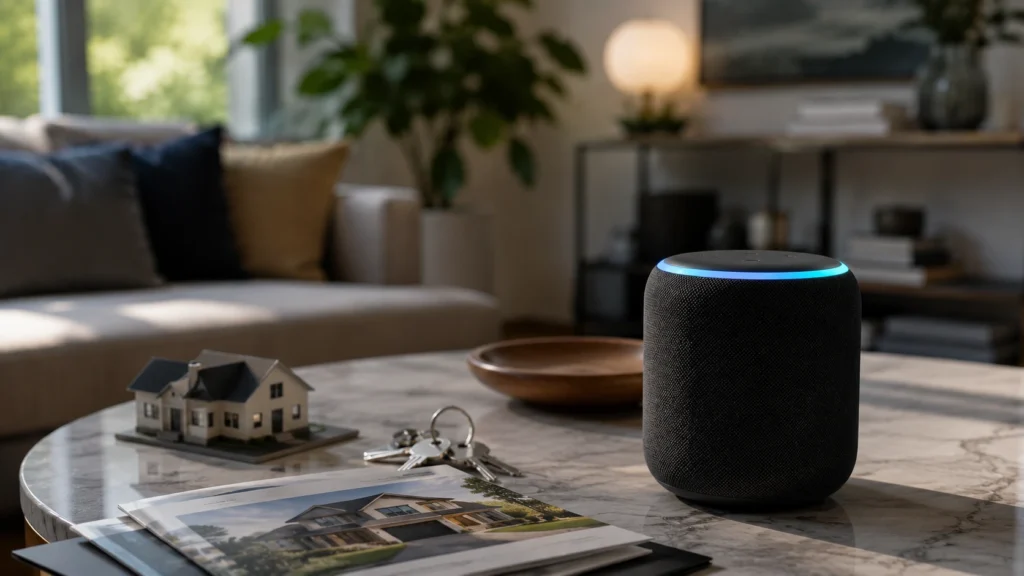

Your visibility hasn’t declined because your content got worse. It’s declined because the place buyers go first has changed, and your name isn’t there.
Answer Engine Optimization (AEO) is the practice of structuring your content so AI systems like ChatGPT, Google’s AI Overviews, and voice assistants pull your answers directly into their responses, before a user clicks a single link. For real estate agents, that’s the difference between being the name a buyer already has in mind and being someone they never considered.
Key Takeaways
- AEO targets AI-generated answers, not ranked blue links. It’s a structurally different challenge from traditional SEO.
- Most real estate agents are invisible in AI search because their content isn’t built to answer specific buyer and seller questions directly.
- Agents who appear in AI responses get named during the buyer’s research phase, before the formal agent search even begins.
- Structured data, question-based content, and locally specific detail are the three core pillars of real estate AEO.
- Waiting isn’t a neutral position. Agents building this content now are claiming territory that compounds over time.
What Does AEO Actually Mean for a Real Estate Agent?
AEO is how your name, your expertise, and your local market knowledge get into the answer an AI delivers before a buyer clicks anything. Not a higher page-one ranking. Not more backlinks. Getting cited by the AI itself as the relevant local authority.
When someone asks ChatGPT “who’s the best real estate agent in [your city] for first-time buyers,” the AI doesn’t run a live Google search. It draws from content it has already processed, structured sources it considers credible, and signals that indicate genuine local expertise. If your content isn’t built to answer that kind of question directly, you’re simply not in the conversation. The detailed guide on how to rank in ChatGPT as a local real estate agent walks through exactly what content and technical moves create that outcome.
Why Traditional Real Estate Marketing Doesn’t Translate to AI Search
A strong Google ranking can create a false sense of security when it comes to AI visibility. You can sit on page one of Google and still be completely absent from every AI-generated response, because the signals driving those two outcomes are fundamentally different.
Traditional real estate marketing, neighborhood landing pages, listing descriptions, keyword-optimized bio pages, was built for crawlers that index and rank. AI systems don’t rank. They synthesize. They pull structured, authoritative, conversational answers from content that directly addresses a specific question someone actually asked.
A listing description written to rank for “3-bedroom homes in [city]” does nothing for the buyer who asks an AI assistant, “What should I know before buying a home in [city] as a first-time buyer?”
The mechanism matters here. When someone types a question into ChatGPT, the system is looking for content that answers that exact question completely and credibly. A keyword-dense listing page doesn’t look like an answer. It looks like marketing copy. The AI skips it.
Consider what this looks like in practice. A buyer relocating from another state spends two weeks asking ChatGPT and Google’s AI Overview detailed questions about neighborhoods, school districts, and market conditions in their target city. By the time they’re ready to contact an agent, they already have a name in mind. That name came from the AI responses they received during research. They didn’t scroll through a directory. The AI surfaced a specific agent through repeated, relevant, locally grounded answers. That agent gets the call without ever competing for it in a traditional search context.
That’s the mechanism AEO creates. You get named before the buyer starts their formal agent search. Your competition doesn’t even know they lost.
How AI Systems Decide Which Real Estate Agents to Surface
This is the question most agents never think to ask, and it’s where the real leverage sits.
AI systems favor content that does three specific things.
First, it answers a discrete, conversational question completely. Not “here are some tips about buying a home.” A full, self-contained answer to something like “what does a buyer’s agent actually do during closing?” That completeness signals to the AI that your content is reliable enough to surface.
Second, it demonstrates local specificity. Writing “the [city] market typically sees competitive multiple-offer situations on properties under $500K through late spring” is more citable than “the market is competitive.” The AI is looking for the kind of detail that only someone with real local knowledge would know. Specificity is the authority signal, not enthusiasm or volume.
Third, the content is structured so the AI can extract it cleanly. That means question-based headings, direct definitions, and short answer blocks that stand alone as useful responses. The guide on AEO for local businesses and how to show up in near-me and voice searches covers how this structural approach applies specifically to local service providers, including agents working defined geographic markets.
A Practical Content Framework for Real Estate AEO
The core structure is straightforward, but most agents skip it because it feels counterintuitive. You’re writing so AI systems can extract a clean answer and attribute it to you, not primarily for human readers to browse.
Every piece of content should start with a specific, conversational question a local buyer or seller would actually ask an AI. Not “real estate tips.” Something like: “What’s the average closing timeline for a home in [city] right now?”
The first paragraph answers that question completely, in roughly 40 to 60 words, without hedging. The AI needs a clean, extractable answer block. That’s what gets cited.
Follow that direct answer with market-specific context only a local expert would know. This is what separates your content from a generic real estate blog and signals to the AI that you’re a credible local source.
Close each content piece with a clear next step tied to the question. Something like: “If you’re buying in [neighborhood], here’s what to watch for at the inspection stage.” This keeps the content useful and signals that you’re a practicing agent, not a template farm.
Apply this structure to every FAQ page, every neighborhood guide, every “what to expect” article you publish. The breakdown of how businesses use AEO to generate leads covers how this same structure applies across local service categories, not just real estate.
AEO vs. Going It Alone: What Each Path Actually Produces
| Factor | No AEO Strategy | With AEO Content Structure and Guidance |
|---|---|---|
| Where buyers find you | Google directories, referrals | AI-generated responses, voice answers, AI Overviews |
| When you enter the buyer’s awareness | After they start searching for agents | During research phase, before they search for agents |
| Content format | Keyword-optimized pages | Question-anchored, direct-answer structured content |
| Competition | Every agent in your market | Whoever builds AEO content first in your area |
| Lead quality | Mixed intent | High intent, already in research or decision phase |
| Trajectory | Declining share as AI search grows | Growing visibility as AI search share increases |
| Risk of inaction | Feels manageable in the short term | Compounds as competitors claim AI-visible territory |
Traditional marketing isn’t obsolete. But it optimizes for a channel that’s no longer the first stop for a growing share of buyers. Agents who are losing ground aren’t doing anything wrong. They’re building for a layer that’s no longer the primary decision point.
What AEO Doesn’t Fix
This matters, because AEO gets you into the AI response. It doesn’t close the deal.
If your follow-up process is slow, your reviews are thin, or your website doesn’t convert when someone lands on it, AEO delivers a warm lead to a cold experience. That’s a funnel problem, not an AEO problem. You need both working.
AEO built on generic content also doesn’t work. If your neighborhood guides read like they were written by someone who’s never set foot in the area, the AI won’t treat them as authoritative. Specificity isn’t a nice-to-have. It’s the whole mechanism.
And AEO doesn’t deliver immediate results for agents starting from a sparse website. The framework requires content that’s already published and structured correctly. There’s no shortcut through the content creation phase. The timeline for when your content starts appearing in AI responses depends on how much relevant local content you already have indexed, how competitive your market is, and whether your content includes direct-answer blocks that AI systems can extract cleanly. Starting with a focused set of high-intent buyer and seller questions specific to your market is the most direct path to building that foundation. The guide on getting your business featured in AI search results across Google’s AI Overviews and ChatGPT covers both the technical and content-side requirements for earning that visibility.
Who This Matters Most For
AEO has the greatest impact when your buyers are doing significant research before contacting an agent.
Relocation buyers, first-time buyers, and luxury buyers all spend more time in the AI research phase than repeat buyers who already have an established agent relationship. If your market skews toward those profiles, AEO isn’t optional. It’s where your leads are forming before you even know they exist.
This pattern isn’t unique to real estate. The broader look at how local businesses are using AI to build visibility shows the same shift playing out across every local service category that relies on trust-based, research-driven buyer decisions.
It also matters most in competitive urban and suburban markets where many agents share similar SEO profiles. When everyone ranks for the same keywords, the agent who appears in AI responses has a structural advantage that traditional SEO alone can’t replicate. Building that advantage now, while most competitors haven’t started, is the clearest path to durable local visibility. The deeper look at why luxury real estate agents are becoming invisible in AI search explains how this plays out specifically at the high-end of the market.
Frequently Asked Questions
How long does it take for AEO content to start appearing in AI responses?
There’s no fixed timeline, and anyone who gives you a guaranteed number is guessing. What you can control is the quality of the content structure you build. Agents who start with 10 to 15 high-intent, locally specific questions and answer each one directly in the first paragraph of a dedicated content piece build the foundation faster than those who retrofit existing generic content. The variable is how competitive your market is and how much credible local content you already have indexed.
Do I need technical skills to implement AEO for my real estate business?
No. The core of AEO for real estate agents is content structure, not code. You’re writing question-based content with direct answer blocks, keeping your Google Business Profile complete and consistently updated, and building local authority through specific, useful content. Schema markup helps, and most current real estate website platforms support it natively. The content layer is where most agents underinvest, and that’s where the real work is.
Is AEO the same thing as voice search optimization?
They overlap significantly but aren’t identical. Voice search optimization is a subset of AEO. When someone asks a voice assistant “who’s a good real estate agent near me,” that’s a voice query. When someone asks ChatGPT a detailed question about your local market, that’s a conversational AI query. Both reward the same content structure: direct answers, local specificity, and question-based formatting. Building for one effectively builds for both.
Will AEO replace my need for traditional Google SEO?
Not entirely, and probably not soon. Google still drives meaningful real estate search traffic, and traditional SEO still matters for buyers who are actively clicking through to listings and agent profiles. AEO addresses the earlier stage of the buyer journey, when they’re asking questions rather than clicking links. The agents who build durable visibility are doing both rather than choosing between them.
What kind of content actually gets cited by AI systems for real estate queries?
AI systems most often cite content that is specific, locally grounded, and answers a question directly in the first paragraph. Neighborhood guides that name specific streets, schools, and current price ranges outperform generic “living in [city]” articles. FAQ pages that answer real buyer objections in plain language outperform promotional bio pages. The more specific and directly useful the answer, the more likely the AI treats it as worth surfacing.
How does AEO help with “near me” searches buyers use on mobile?
Near-me queries are processed using a combination of your Google Business Profile signals, your website’s local content, and structured data confirming your service area. For real estate agents, this means your GBP needs to be complete and consistently active, your website needs to reference specific neighborhoods and cities in a structured way, and your content needs to answer the questions buyers ask when they’re researching a specific area. These signals work together rather than independently, so a gap in any one area limits what the others can accomplish.
What’s the biggest mistake real estate agents make when trying to implement AEO?
Writing content for humans to read rather than for AI systems to extract. Agents who struggle with AEO typically write long narrative neighborhood guides that bury the direct answer in the third paragraph. AI systems need the answer in the first 60 words, followed by supporting detail. If you make the AI work to find your answer, it’ll surface someone else’s instead. Lead with the answer. Then support it.
About the Author: Dave Bernard is a professional marketer with a focus on AI-driven marketing strategies and Answer Engine Optimization. His work centers on helping local businesses and entrepreneurs build sustainable online visibility in AI-driven search environments. He publishes actionable strategies and step-by-step guides at easysolution4you.com.