
When someone asks an AI assistant which local business solves their specific problem, one business gets named. Every other option gets bypassed entirely. That’s not a traffic dip you’ll catch in your analytics. It’s a structural visibility gap, and it’s already forming around local businesses that haven’t formatted their content for how AI retrieval actually works.
Key Takeaways
- AEO formats your content so AI retrieval systems can extract your business as the direct answer to a specific local question
- Traditional SEO earns a position in a ranked list; AEO earns a citation in a direct AI response, and these two outcomes require completely different content structures
- The most common AEO mistake is layering optimized content on top of an incomplete entity foundation, which produces content that exists but can’t be cited
- Local service businesses in competitive markets face compounding visibility loss the longer this structural shift goes unaddressed
- Businesses that move early on local AEO hold a durable positional advantage because most local competitors haven’t made this shift yet
Why Does Inquiry Volume Drop Even When Rankings Look Fine?
There’s a specific pattern showing up for local service businesses right now. Traditional ranking positions look stable. Website traffic hasn’t collapsed. And yet the phone isn’t ringing the way it used to.
That gap has a structural explanation.
When someone asks a voice assistant which plumber handles emergency weekend calls, or types a full conversational question into an AI-powered interface, they don’t get ten blue links. They get a direct answer with a cited source. One answer. Often one business is named. The business earning that citation wins the inquiry before any comparison even begins.
Your traditional ranking positions can stay completely stable while actual inquiry volume drops. There’s no penalty notice. There’s no flag in your analytics. AI-generated responses are resolving questions before users even reach a traditional results page. If your content isn’t structured to be the extracted source for that response, you’re not being outranked. You’re being skipped before the comparison starts.
This is the core problem that AEO for local businesses is built to address. It’s not SEO with a new label. It runs on different logic entirely, and treating it as a minor update to your current content strategy is one of the more costly assumptions a local business can make right now.
What Does AEO Actually Do Differently From Traditional SEO?
Traditional SEO sends signals to search engines that your page is relevant to a given topic. AEO sends signals to AI retrieval systems that your content contains a direct, extractable answer to a specific question, and that your business is a credible local entity worth citing.
That distinction carries real structural consequences.
A traditional SEO page covering home inspection services earns ranking by addressing the topic broadly, weaving in relevant terms, and accumulating backlinks. An AEO-structured page does something different. It answers a specific question directly in the opening line of the relevant section. It uses schema markup to signal entity type, service category, and geographic location. It includes consistent business data that AI systems can cross-reference to confirm your business is a real, operating local entity in a specific geography.
AI retrieval systems don’t browse your site looking for the best-written paragraph. They extract structured answers. If your content doesn’t present information in a cleanly extractable format, it won’t earn citations regardless of how thorough or genuinely useful the writing is.
The problem isn’t the quality of what you’re writing. The problem is how it’s structured.
You can get a full breakdown of how this structural difference plays out in practice by reading through the AEO lead generation framework for local businesses. That’s where the foundational mechanics are laid out step by step.
Which Local Businesses Face the Highest Visibility Risk Right Now?
Not every local business faces equal exposure to this shift. The risk is highest where two conditions overlap: buyers use conversational, question-based queries to find service providers, and the local market is competitive enough that AI systems have multiple sources to choose between when selecting a citation.
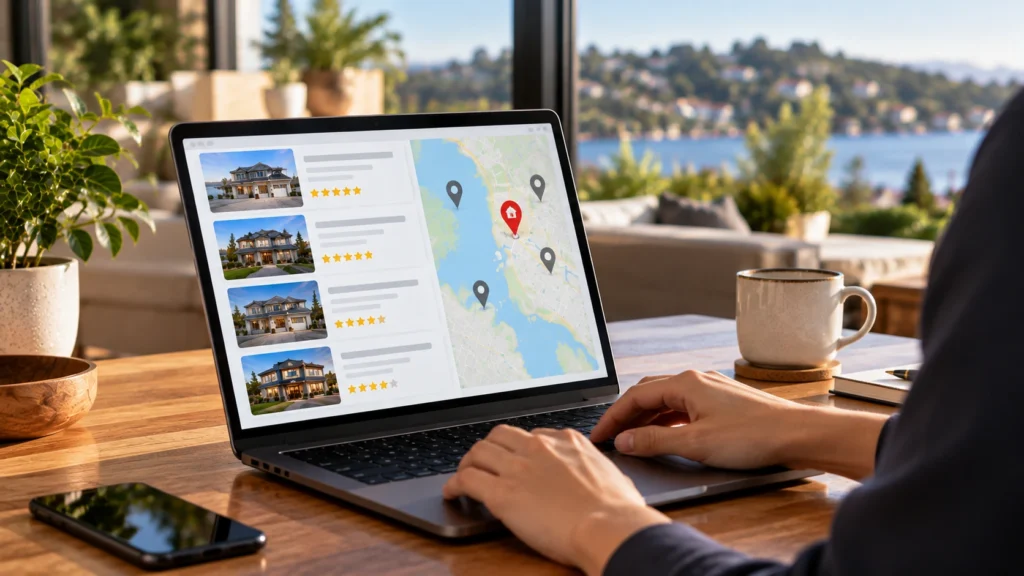
Consider a typical situation in a competitive real estate market. A buyer asks a voice assistant which agent handles waterfront properties near a specific neighborhood. The AI needs to cite someone. One agent has a page that directly answers what a buyer should look for in a waterfront specialist, structured with clear headings, proper schema markup, and consistent business information across directories. Other agents in the same market cover the same topic, but the useful content is buried three sections deep inside a general blog post. An AI retrieval system can’t cleanly extract a buried answer, so it moves past it in favor of the structured one.
That agent didn’t necessarily write better content. They wrote better-structured content. That’s the entire distinction.
This pattern is particularly sharp for real estate professionals, where the specificity of local queries maps directly to the geographic precision that AEO rewards. The guide on why luxury real estate agents are becoming invisible in AI search walks through the specific mechanism driving that visibility loss and what the structural correction looks like in practice.
What Sequencing Mistake Wastes Most AEO Effort?
The most common AEO mistake isn’t ignoring it. It’s implementing it in the wrong order.
If your business has no verified Google Business Profile, inconsistent name and address and phone data across directories, and no established content base, starting with AEO content optimization gets the sequence completely backwards. You’d be structuring content for extraction before giving AI systems anything credible to extract from.
Extraction logic depends on entity recognition. Entity recognition depends on consistent, verifiable signals that your business is a real local entity operating in a specific geography. Without those foundational signals, even well-structured answer content won’t earn reliable citations, because the AI system can’t confirm the entity it’s evaluating.
The right sequence starts at the foundation: consistent business data across directories, a complete and verified Google Business Profile, and a clean baseline of local content establishing what your business does and where it operates. AEO-structured, question-answering content layers on top of that foundation, not before it.
One genuine limitation worth naming directly: AEO doesn’t fix a conversion problem on its own. If your content earns a citation, a prospect calls, and no one answers or follow-up is slow, that lead disappears regardless of how strong your optimization is. The piece on how local businesses are using AI to recover lost time and missed opportunities covers how the operational side of that gap gets addressed, so the visibility work you’ve done actually converts into real inquiries rather than missed calls.
How Do the Paths Forward Actually Compare?
There are three realistic paths for a local business facing declining AI search visibility. Understanding where each one breaks down is more useful than a surface-level comparison.
Maintaining traditional SEO alone works if your buyers are still resolving searches through traditional results pages and your competitors haven’t moved into AEO yet. In most competitive local service markets, that window is narrowing. Traditional SEO doesn’t generate AI citations and doesn’t address conversational voice query formatting.
Running paid advertising fills an immediate lead generation gap but creates a structural dependency. The moment the budget stops, the visibility stops. Paid placement also doesn’t build the citation authority that AI systems use to recommend businesses organically.
Building AEO takes longer to produce citations than paid ads do. That’s a real tradeoff worth naming honestly. But citation authority compounds once it’s established, and a business that earns consistent AI citations in its local market doesn’t need to outspend competitors to stay visible.
| Factor | Waiting or Doing Nothing | Paid Ads Without AEO | Building AEO with Qualified Guidance |
|---|---|---|---|
| Visibility in AI-generated answers | None, actively declining | None | Direct structural mechanism built for this outcome |
| Long-term cost structure | Compounding visibility loss with no ceiling | Ongoing spend required indefinitely | Builds citation authority that accumulates over time |
| Voice search coverage | None | None | Core target of the entire approach |
| Dependency risk | Competitors build authority while you wait | Stops completely when budget stops | Distributed across platforms, not budget-dependent |
| What happens when you stop | Continued decline | Visibility disappears immediately | Citation authority persists and continues to build |
Inaction isn’t a neutral position. Every month a competitor in your local market builds citation authority is a month they’re being cited instead of you.
How Can You Test Whether Your Content Is AEO-Ready Right Now?
Take the most important question a buyer in your market asks before hiring someone in your service category. Type that exact question into an AI search tool. See who gets cited.
Then find where your own website answers that question.
If the answer is buried inside a long page, has no heading that reflects the question, and carries no schema markup to signal what type of content it contains, your content exists but it can’t be extracted. AI systems move past it. Not because it’s poorly written, but because the structure doesn’t signal what it’s answering.
The visibility problem isn’t that your content got worse. The format of the answer changed, and most local businesses haven’t changed with it.
For a broader view of where AI tools are reshaping local search visibility, the overview of AI tools transforming online business provides useful context on where this shift is heading. The step-by-step guide on getting your business featured in Google SGE and ChatGPT results connects voice search strategy directly to the broader AEO approach for businesses ready to act on this now.
Frequently Asked Questions
What is Answer Engine Optimization and how is it different from SEO?
AEO is the practice of formatting your content, schema markup, and authority signals so AI retrieval systems can extract and cite your business as the direct answer to a specific query. Traditional SEO optimizes for ranking position in a list of results. AEO optimizes for being the cited source in an AI-generated response. The signals that drive each outcome overlap in places, but they aren’t identical. Treating AEO as a renamed version of SEO is the assumption that keeps most local businesses invisible in AI search.
How long does it take to see results from AEO for a local business?
Results depend on how complete your foundational entity signals are before you start, and how competitive your local market is. Content structured with direct-answer formatting and proper schema markup can begin appearing in AI-generated citations before broader authority is fully established. Building consistent citation authority across multiple relevant local queries takes sustained content and authority work over several months. That authority compounds once it’s in place, which is why starting earlier produces structurally better outcomes than waiting.
Does AEO require a large budget to implement?
AEO is primarily a structural and content challenge, not a budget challenge. The core requirements are properly formatted content, schema markup, consistent business data across directories, and a sustained authority-building strategy. These don’t require significant ad spend. What they require is understanding how AI retrieval systems evaluate and extract information, then applying that structure consistently. The cost of not implementing it compounds in ways that paid alternatives can’t fix.
Can a small local business realistically compete with larger brands in AI search?
Yes, specifically at the local query level. AI systems responding to queries like “best home inspector near Fort Lauderdale” are looking for the most credible local entity with the most extractable answer, not the largest brand nationally. A small business with properly structured local content and strong entity signals can earn citations that a large national brand doesn’t have the geographic specificity to win. Local AEO rewards specificity rather than scale.
What’s the real cost of waiting several months before addressing AEO?
The cost isn’t static. It compounds. Every month a competitor in your local market builds citation authority is a month they’re being cited instead of you. AI systems develop citation patterns based on accumulated authority signals, and reversing an established pattern takes longer than building one from scratch. Waiting feels like a neutral choice. It isn’t.
Do I need specialist help to implement AEO, or can I handle it myself?
The technical components of AEO, specifically schema markup, structured data implementation, and entity optimization, carry a real learning curve. The content strategy components are learnable, but they require understanding how AI retrieval logic evaluates and extracts information. Businesses that attempt AEO without that foundational understanding typically produce content that reads well but doesn’t earn citations. The structural gap between readable content and extractable content is exactly where qualified guidance pays for itself.
How does voice search connect to AEO for local businesses?
Voice queries are almost always conversational and location-specific. Think “who handles waterfront property listings near Fort Lauderdale” rather than “Fort Lauderdale real estate agent.” Your content needs to contain a direct, extractable answer to that conversational phrasing, not a paragraph that eventually covers the topic somewhere in the body copy. Voice queries also carry high intent because people asking specific local questions are typically close to a decision. Structuring content for voice extraction is one of the highest-return applications of AEO for any local service business.
About the Author
Dave Bernard is a professional marketer based in Southern Florida, specializing in Answer Engine Optimization and AI-driven visibility strategies for local businesses and entrepreneurs. His work focuses on practical, step-by-step frameworks that help business owners compete in AI-powered search environments. Dave publishes actionable guides and strategy resources at easysolution4you.com.