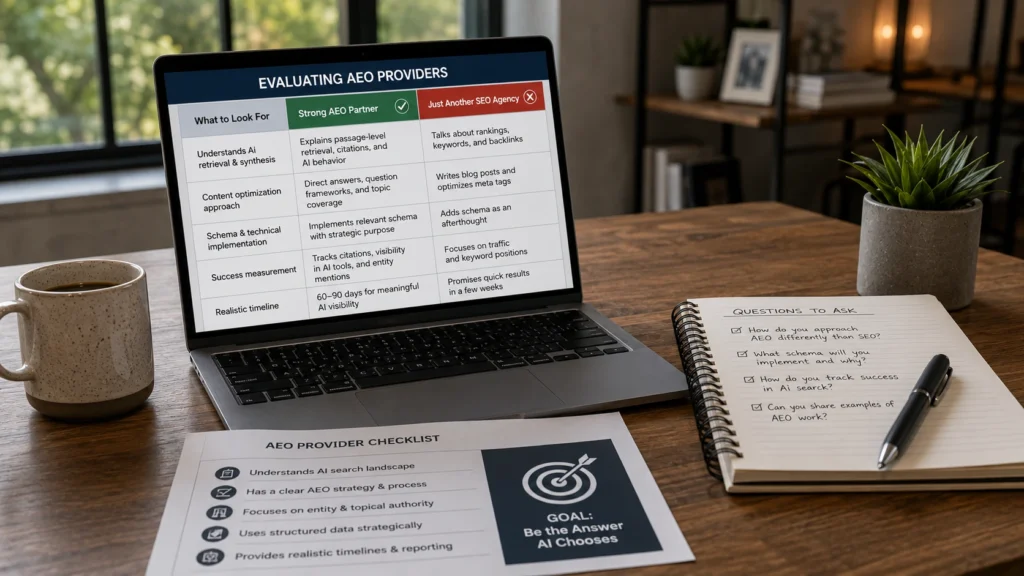

Answer Engine Optimization is the discipline of structuring your content so that AI-powered search tools, including ChatGPT, Google AI Overviews, and voice assistants, extract and surface your answers directly in their responses. The challenge isn’t finding providers who claim to do this. It’s identifying which ones actually understand how AI retrieval works.
Key Takeaways
- Confident AEO pitches and repackaged SEO pitches sound almost identical. The difference shows up in the mechanism, not the vocabulary.
- Real AEO targets passage-level retrieval. Providers who talk about “rankings” are still thinking in traditional SEO terms.
- Use the five-question diagnostic below to separate practitioners from vendors before you commit.
- Honest AEO timelines run 60 to 90 days for meaningful citation visibility. Shorter promises aren’t aggressive goals, they’re a red flag.
- Structured data, entity clarity, and answer completeness are the three technical pillars that separate real AEO implementation from surface-level content rewrites.
Why Is It So Hard to Tell Real AEO Work From Repackaged SEO?
Because the vocabulary is almost identical.
Both camps use words like “authority,” “visibility,” and “structured content.” Both will mention schema markup. Both will show you screenshots of AI-generated answers. The difference isn’t in what they say. It’s in whether they understand why those answers get retrieved.
Traditional SEO optimizes for a crawl-and-rank system. A crawler indexes pages and scores them against authority signals. AEO optimizes for a retrieval-and-synthesis system, where an AI pulls the most direct, contextually complete answer to a specific question and generates a response around it. Optimizing for one system doesn’t automatically optimize for the other, because the machines work differently at a fundamental level.
The provider who treats AEO as “SEO with a chatbot layer” will cost you months of wasted effort and budget before the gap becomes undeniable.
If you want to understand how these two disciplines diverge in practice, the AEO guide covering how businesses generate leads through answer-focused content is a practical place to start. That page is part of Dave Bernard’s own content library at easysolution4you.com, where he publishes these frameworks directly.
What Does a Provider Actually Need to Know to Do AEO Correctly?
Three things. If a provider can’t explain all three at the mechanism level, they’re not ready to do the work.
Retrieval architecture. AI systems don’t rank pages. They retrieve candidate passages and synthesize responses from them. Your content needs to be structured so that specific passages answer specific questions completely, without requiring the AI to read surrounding context to fill in the meaning. A provider who doesn’t grasp this will optimize your page title and call it AEO.
Entity clarity. AI systems build understanding through named entities and their relationships. If your content doesn’t clearly establish who you are, what you do, where you operate, and who you serve, the AI has no reliable basis for including you in a relevant answer. This is why local businesses that haven’t structured their content for near-me and voice searches are losing ground to competitors who have. Entity clarity isn’t optional. It’s the foundation.
Answer completeness. The retrieval system rewards content that answers a question fully within a contained passage. Not a paragraph that points toward an answer somewhere else on the page. The answer itself, stated directly, in full. Providers who understand this will restructure your content at the sentence and paragraph level. Providers who don’t will add an FAQ section and consider the job finished.
The Five-Question Diagnostic: How to Evaluate Any AEO Provider Before You Commit
This diagnostic works because it asks for mechanism, not credentials. Ask these questions in your first conversation.
Question 1: “What’s the difference between optimizing for Google AI Overviews versus ChatGPT citations?”
A practitioner will explain that Google AI Overviews draws from indexed pages with established E-E-A-T signals, while ChatGPT citations depend on training data patterns and structured content that’s easy to extract and synthesize. A vendor will give you something vague about “being authoritative across platforms.”
Question 2: “How do you handle entity disambiguation for a local business?”
This one filters quickly. If they don’t know what entity disambiguation means in the context of AI retrieval, they’re not doing real AEO.
Question 3: “What schema types do you implement, and why does each one matter?”
Acceptable answers include FAQ schema, HowTo schema, LocalBusiness schema, Speakable schema, and Person schema, with specific reasons tied to retrieval behavior for each. “We implement structured data” is not an answer.
Question 4: “How do you measure AEO success before a page gets cited in an AI response?”
This reveals whether there’s a real process in place or whether they’re waiting and hoping. Real leading indicators include passage-level answer completeness reviews, schema validation results, and entity coverage audits.
Question 5: “What’s a situation where AEO won’t work for a client?”
Any provider who can’t answer this is selling, not advising. Knowing the limits of a discipline is a core indicator of genuine expertise.
Consider a common scenario: a real estate agent in a competitive metro market hires a provider who passes questions one and three but can’t answer question two. The result is technically clean schema, no entity clarity, and months of AI responses that name every competitor in the area except them. Entity structure was the gap the whole time. The non-obvious detail that separates practitioners from vendors is knowing that schema without entity work is decoration.
What Should Realistic AEO Timelines Actually Look Like?
This is where the most damage happens. Providers overpromise because honest timelines are harder to sell than fast ones.
Weeks 1 through 4 involve technical audit, schema implementation, entity structure work, and content restructuring at the passage level. No visible results yet. This is foundation work, and it’s not glamorous, but skipping it means everything that follows doesn’t hold.
Weeks 5 through 8 are when content gets indexed, schema gets validated, and entity associations start registering in AI systems. You may begin seeing your content appear in AI-generated answers for lower-competition queries during this window.
Weeks 9 through 12 are when broader citation visibility for your core topics becomes realistic, assuming the earlier work was done correctly. For real estate agents and local business owners, this is typically when names start appearing in “who are the top service providers in this area” type responses.
The honest number is 60 to 90 days for meaningful citation visibility. Anyone promising results in two weeks either doesn’t understand what AEO measures or is working in niches with no competition worth mentioning.
If you’re a real estate agent trying to show up when buyers ask AI assistants for agent recommendations, the step-by-step breakdown of how to rank in ChatGPT as a real estate agent gives you a realistic picture of what that process actually involves.
Comparing Real AEO Practice Against Doing Nothing or Going It Alone
| Evaluation Dimension | Working With a Qualified AEO Practitioner | Waiting, Doing Nothing, or Relying on Traditional SEO Alone |
|---|---|---|
| Primary optimization target | Passage-level answer retrieval for AI systems | Page-level keyword rankings for crawl-based search |
| Schema approach | Query-specific schema types with retrieval reasoning | Generic schema added as an SEO afterthought |
| Entity strategy | Named entity mapping and disambiguation | An author bio and an “about” page |
| Content restructuring | Sentence and paragraph-level answer completeness | Header rewrites and meta description updates |
| Success measurement | Schema validation, passage completeness, citation tracking | Organic traffic and keyword position |
| Timeline honesty | 60 to 90 days for citation visibility | No AEO visibility at all, regardless of timeline |
| Local business application | Near-me query optimization and voice search structuring | Local keyword density in page copy |
The right comparison isn’t qualified AEO help versus cheaper alternatives. It’s acting now versus letting competitors establish AI citation authority while you wait. The cost of inaction isn’t neutral. Every month a competitor’s content gets cited in AI responses to the questions your prospects are asking is a month their entity signals compound and yours don’t.
Where This Framework Doesn’t Apply
This evaluation framework assumes you’re already comparing providers who claim AEO expertise. It’s not built for someone still deciding whether AEO is worth addressing at all.
If your business has no indexed content, no schema in place, and no established digital presence, the provider evaluation question is premature. Foundation work comes first.
This framework also won’t help you if you’re expecting a one-time fix. AEO isn’t a campaign with a delivery date. It’s an ongoing alignment between your content structure and how AI retrieval systems evolve. Providers who sell it as a one-time deliverable are selling the wrong product regardless of how well they score on the diagnostic above.
If you’re a local business owner still working out whether AI search is actually affecting your lead flow, the overview of how local businesses are using AI to maintain visibility is a better starting point than an evaluation framework. Understand the problem clearly before you evaluate anyone’s solution to it.
The most dangerous AEO provider isn’t an obvious fraud. It’s the competent SEO agency that genuinely believes its existing playbook transfers to AI retrieval. They’ll do real work, charge real fees, and leave you optimized for a system that’s no longer the first stop for most search queries.
Frequently Asked Questions
How do I know if my current provider is doing real AEO or just applying SEO with different labels?
Ask them to show you a specific piece of content they restructured for passage-level answer retrieval, not keyword coverage. If they can’t point to a concrete passage-level change and explain why it improves AI citation probability, they’re doing SEO. Real AEO changes how individual paragraphs are constructed, not just what topics are addressed on a page.
How long does it realistically take for my business to appear in AI search responses?
Expect 60 to 90 days from the point when technical implementation is complete and content is indexed. The timeline depends on how competitive your topic area is and how thoroughly your entity structure has been established. Providers promising citation visibility in under 30 days are either working in extremely low-competition niches or setting expectations they can’t meet.
Can a small local business compete in AI search against larger brands?
Yes, and sometimes more effectively than in traditional search. AI retrieval systems reward answer completeness and entity clarity, not just domain authority. A local business with tightly structured, location-specific content that directly answers the questions its prospects are asking can outperform a national brand with broad, generic content. The specificity of your entity structure matters more than the size of your domain.
What’s the difference between Google AI Overviews and ChatGPT citations, and should I optimize for both?
Google AI Overviews pulls from pages already indexed in Google’s system, so strong E-E-A-T signals and appropriate schema are the primary levers. ChatGPT citations depend on training data patterns and structured content that’s easy to extract and synthesize into a response. The underlying principles overlap, but the technical implementation differs enough that a qualified provider should address both explicitly rather than treating them as a single target.
Is AEO worth pursuing if my organic search traffic is already low?
Low organic traffic is a reason to prioritize AEO sooner, not later. If your content isn’t getting found through traditional search, AI-driven search represents a different path to visibility that doesn’t depend on the same domain authority signals. Getting your content structured for AI retrieval builds a foundation that compounds as AI-first search behavior continues to grow. It’s not a substitute for fixing your broader content strategy, but it’s a parallel track worth building.
What schema types matter most for a real estate agent pursuing AEO?
LocalBusiness schema establishes your geographic entity clearly. FAQ schema structures your answers for direct retrieval. Speakable schema flags specific passages as appropriate for voice assistant responses. Person schema ties your name and professional identity to your content. A provider who can’t name these and explain when each one applies isn’t doing real AEO for local businesses.
How do I evaluate an AEO provider’s track record when citations are hard to verify and screenshot?
Ask for process documentation rather than outcome screenshots. This means before-and-after content showing passage-level restructuring, schema validation reports, and entity coverage audits. These are the artifacts of real AEO work. If a provider’s only proof is “look, we appeared in this AI answer,” they can’t show you why it happened or how to replicate it. A provider who understands the mechanism can document the work, not just point to a result.
Dave Bernard is a professional marketer based in Canada with experience in digital marketing strategy, Answer Engine Optimization, and AI-driven visibility. He publishes actionable frameworks for entrepreneurs and local businesses at easysolution4you.com, his own website.