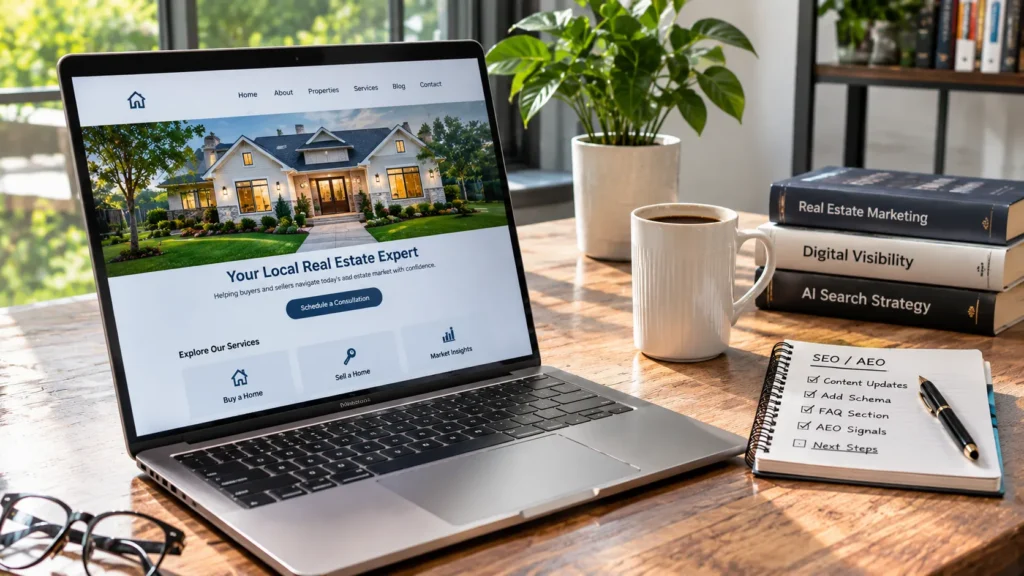

No. For most websites with crawlable HTML and existing content, Answer Engine Optimization (AEO) is an editing and structuring project, not a complete rebuild. Improving AI search visibility usually involves making your content easier to understand, extracting clear answers, implementing appropriate schema markup, and strengthening your website’s existing information architecture.
AI-powered search platforms such as Google AI Overviews, ChatGPT, and Perplexity use different retrieval and citation methods, but all benefit from accessible, relevant, trustworthy content. A website doesn’t need to be new to meet those requirements.
Key Takeaways
- AEO can usually be implemented on your existing website without changing platforms.
- Clear, direct answers help make content easier for search engines and AI retrieval systems to interpret.
- Article, FAQPage, and other relevant schema types provide additional context about your content, although they don’t guarantee AI citations.
- A complete website rebuild is generally unnecessary unless significant technical limitations prevent content from being accessed or maintained.
- Small and local businesses can begin by optimizing three to five important existing pages.
- Traditional SEO and AEO work together to improve content discoverability, relevance, and authority.
Why Do People Think They Need to Rebuild Their Website for AEO?
The assumption is understandable. AI-powered search feels different from traditional Google search, so business owners often assume they need an entirely different website to compete.
That isn’t usually the case.
Answer Engine Optimization focuses on making website content accessible, understandable, and useful for systems that generate answers to user questions.
Traditional search engines generally present ranked search results, while AI-powered experiences may summarize information from multiple sources and cite supporting websites.
Both rely on many overlapping foundations, including:
- Accessible website content
- Clear page structure
- Relevant information
- Reliable sources and expertise
- Internal linking
- Technical crawlability
A WordPress website built several years ago can still be a strong candidate for AI search visibility when its content clearly addresses customer questions.
Similarly, a newly designed website may struggle if it contains vague service descriptions, limited supporting information, or important content that search systems cannot access.
The age of your website matters far less than the accessibility, relevance, and quality of the information it provides.
The misconception comes from treating AEO as a complete website replacement strategy when it is more accurately an extension of existing SEO and content optimization practices.
What Actually Determines Whether Your Existing Website Works for AEO?
Three important conditions help determine whether your website can support an effective AEO strategy.
1. Your Website Provides Crawlable Content
Search engines and AI retrieval systems need access to your content before they can evaluate or reference it.
If important information is only available through client-side JavaScript rendering, some crawlers may have difficulty accessing it.
Other potential barriers include blocked resources, incorrect robots directives, authentication requirements, and technical errors.
However, these issues do not automatically require a complete rebuild.
Depending on the website, solutions may include:
- Adjusting rendering configurations
- Implementing server-side rendering
- Correcting robots.txt restrictions
- Resolving indexing and crawl errors
- Improving internal navigation
The objective is to make important content accessible without unnecessarily replacing the existing website.
2. Your Content Answers Specific Questions
A general service description may tell visitors what your company offers, but it doesn’t always answer the questions potential customers are asking.
For example, a real estate website might include a page titled “Our Buyer Representation Services.”
That page could become more useful by directly answering:
What does a buyer’s agent do when housing inventory is low and offers are competitive?
A clear answer might explain how a buyer’s agent evaluates available properties, analyzes comparable sales, develops competitive offers, and helps buyers understand negotiation risks.
This gives readers specific information while making the content easier for retrieval systems to interpret.
The improvement comes from rewriting and organizing the existing content rather than replacing the entire website.
3. Your Website Supports Structured Data
Schema markup is structured data that helps search engines understand the entities and information presented on a webpage.
Common schema types include:
- Article: Identifies editorial content, authorship, and publication information.
- FAQPage: Describes question-and-answer content when appropriate.
- HowTo: Represents instructional content where supported and relevant.
- LocalBusiness: Provides information about a business, its location, and services.
- Organization: Identifies the business or organization responsible for the website.
Structured data can improve how search systems interpret content, but it is not a guaranteed mechanism for obtaining AI citations or rich search results.
Most established content management systems, including WordPress, Wix, and Squarespace, offer ways to implement supported structured data.
For many websites, this can be accomplished without changing the existing design.
A Practical Example
Consider a local real estate agent with a website containing 30 blog posts, several service pages, and an About page.
The website is accessible to search engines, but its articles are written primarily as long narratives.
Instead of rebuilding, the agent could:
- Identify five existing articles addressing high-value customer questions.
- Rewrite the introductions to provide direct answers.
- Improve headings and supporting explanations.
- Add relevant structured data.
- Connect the articles to related service pages.
This approach preserves the existing website while improving its usefulness for traditional and AI-powered search.
What’s the Real Problem With Most Existing Websites?
Many websites were originally written to guide readers through a narrative.
An article might begin with background information, introduce a problem, explain several concepts, and finally provide the answer.
That format can work well for human readers, but it may make specific answers harder to locate.
For AEO, a more useful structure is often:
Direct answer → Supporting explanation → Evidence → Additional context → Next steps
This approach does not require sacrificing detail.
Instead, it presents the most relevant information first and then expands on it.
For example, rather than opening a blog post with several paragraphs about how artificial intelligence is changing digital marketing, a business could begin:
“Most small businesses do not need to rebuild their websites for AEO. They can improve AI search readiness by making existing pages crawlable, answering customer questions directly, strengthening internal links, and implementing relevant structured data.”
The remainder of the article can explain each recommendation.
This structure benefits both readers looking for quick answers and systems processing individual sections of a page.
For real estate professionals, the guide explaining why experienced agents can become less visible in AI search explores how content organization affects discoverability.
Acting Now vs. Waiting: What Does the Decision Actually Cost?
Businesses considering AEO generally have three options: optimize their existing website, postpone implementation, or pursue a complete rebuild.
Each involves different levels of effort.
| Approach | What It Involves | Illustrative Timeframe | Best Fit |
|---|---|---|---|
| AEO optimization of existing pages | Improve answers, headings, internal links, and structured data | 2–6 weeks | Most websites with accessible content |
| Monitoring after implementation | Track indexing, relevant search visibility, AI mentions, and citations | Ongoing; initial reviews after 4–8 weeks | Businesses measuring optimization progress |
| Delaying implementation | Maintain existing content without AEO-focused improvements | No defined implementation timeline | Businesses with more urgent technical or operational priorities |
| Complete website rebuild | Replace or significantly restructure the website | Several months, depending on scope | Websites with major technical or structural limitations |
These timeframes are planning estimates, not guaranteed performance milestones.
AI citation visibility can vary considerably depending on competition, content quality, query type, platform behavior, and the availability of supporting information.
The main advantage of optimizing an existing website is that businesses can begin improving relevant content without waiting for a lengthy redevelopment project.
For real estate professionals, the step-by-step guide to improving visibility in ChatGPT provides additional context on developing content around the questions potential clients ask.
The AEO Entry Sequence for Existing Websites
If your website already has accessible content and an editable content management system, you can begin with a focused optimization process.
Step 1: Identify Three to Five Important Existing Pages
Start with pages that already attract relevant traffic, answer valuable customer questions, or support important business services.
Review available performance data from Google Search Console and website analytics.
Prioritize pages that have clear opportunities for improvement rather than automatically selecting the highest-traffic pages.
Step 2: Add Direct-Answer Introductions
For each selected page, identify its primary question.
Write a concise opening paragraph that answers that question clearly.
Approximately 40–60 words can be a useful editorial target, but the answer should be as long as necessary to be accurate and complete.
Avoid unnecessary introductions that delay the main point.
Step 3: Add Relevant FAQ Sections and Structured Data
Identify genuine follow-up questions related to the page’s subject.
Answer them clearly and specifically.
Where appropriate, implement matching structured data using your CMS or a supported SEO plugin.
Make sure structured data accurately reflects content visible on the webpage.
FAQPage markup should not be treated as a guaranteed way to earn Google FAQ rich results or AI citations.
Step 4: Develop a Dedicated Page for a High-Value Question
After improving existing pages, identify an important customer question that your website does not adequately address.
For example:
“How can a small business appear in AI-generated search answers without rebuilding its website?”
Create a useful resource that answers the question directly, explains relevant considerations, and provides practical guidance.
Avoid creating multiple pages that repeat essentially the same information.
The objective is to provide meaningful topical coverage, not simply increase page count.
Step 5: Strengthen Internal Links
Connect related pages using descriptive, relevant anchor text.
For example, a general article about Answer Engine Optimization might link to more specific resources covering local search visibility, structured data, and AI search content strategies.
This helps visitors discover related information and helps search engines understand relationships between pages.
The AEO guide for local businesses explains how geographic relevance and service-specific content can support local discoverability.
Step 6: Monitor Performance and Refine Content
AEO implementation should be followed by ongoing measurement.
Useful indicators include:
- Organic impressions and clicks
- Search queries associated with optimized pages
- Indexing and crawlability
- Referral traffic from identifiable AI platforms
- AI-generated mentions and citations observed through consistent testing
- Leads and conversions from relevant traffic
No single metric provides a complete picture of AI search visibility.
Reviewing several indicators helps determine whether the improvements are producing meaningful business results.
When Is a Complete Website Rebuild Actually Justified?
A rebuild may be appropriate when existing technical limitations cannot reasonably be resolved through targeted improvements.
Examples include:
Persistent crawlability problems: Important content remains inaccessible despite reasonable attempts to correct rendering, server, or indexing issues.
Severe CMS limitations: The existing platform prevents essential content updates or technical changes, and upgrading or reconfiguring it is impractical.
Fundamentally inadequate website architecture: Navigation, templates, or content organization are so limited that improving individual pages would not address the underlying problems.
Broader business requirements: The organization needs significant changes to functionality, security, accessibility, or maintainability that justify redevelopment independently of AEO.
Even in these situations, a rebuild should be evaluated against less disruptive alternatives.
Website migrations introduce their own risks, including broken links, changed URLs, indexing disruptions, and potential ranking fluctuations.
For most established websites, improving existing content is a more practical starting point.
The guide to getting your business featured in AI search results provides further information on strengthening visibility without relying solely on website redesign.
Frequently Asked Questions
How long does it take to see AEO results on an existing site?
Implementing initial AEO improvements may take approximately two to six weeks, depending on the number of pages, content requirements, and technical complexity. Businesses can begin monitoring search and AI visibility after implementation, but there is no guaranteed timeline for earning AI citations. Results depend on competition, content relevance, accessibility, and the retrieval methods used by individual platforms.
Does my website platform matter for AEO?
Your website platform matters primarily because it affects content accessibility, technical flexibility, and your ability to manage structured data. WordPress, Squarespace, Wix, and other established platforms can support AEO improvements. The platform itself does not guarantee better AI search visibility. Accessible, relevant, trustworthy content remains essential.
Can I implement AEO myself, or do I need guidance?
Many foundational AEO improvements can be completed independently, including rewriting introductions, organizing headings, adding useful FAQs, and implementing supported structured data. Professional guidance may help with technical audits, identifying valuable customer queries, competitive research, and measuring AI search visibility.
Will AEO changes hurt my existing search rankings?
Not necessarily. Improvements such as clearer headings, useful answers, relevant internal links, and accurate structured data can support traditional SEO. However, any substantial content or website change should be evaluated carefully. Removing valuable information, changing URLs without appropriate redirects, or altering page relevance can negatively affect existing rankings.
Do I need new pages, or can I optimize existing ones?
Start by evaluating existing pages. Updating relevant, established content can be more efficient than creating entirely new pages. New pages are useful when important customer questions or topics are not adequately covered by existing content. The priority should be providing distinct, valuable information rather than publishing additional pages unnecessarily.
What’s the practical difference between AEO and traditional SEO?
Traditional SEO focuses on helping webpages become discoverable and competitive in search results. AEO emphasizes making information accessible, understandable, and useful for systems that generate direct answers. The two approaches share important foundations, including crawlability, relevance, authority, and content quality. AEO adds particular attention to clearly answering questions and organizing information so individual passages can be understood in context.
Is AEO worth the effort for a small local business?
AEO can be valuable for small local businesses whose customers use AI-powered tools to research services, compare providers, or ask location-specific questions. Businesses with genuine local expertise can create useful content addressing those needs. For example, a real estate agent might explain the process of purchasing a home in Austin using a VA loan. Accurate, locally relevant answers can strengthen discoverability, although citations and traffic are not guaranteed.
Final Thoughts: Improve What You Already Have Before Starting Over
AEO does not require most businesses to abandon their existing websites.
The more practical starting point is to evaluate whether your current pages are accessible, useful, clearly structured, and relevant to the questions your customers ask.
From there, improvements can be made incrementally.
Start with your most important pages. Make answers easier to find. Strengthen supporting information. Implement appropriate structured data. Connect related content and monitor the results.
A complete rebuild should be a technical or business decision supported by clear evidence, not an assumed requirement for AI search visibility.
The goal isn’t to build a completely different website for AI. It’s to make your existing website a clearer, more useful, and more trustworthy source of information.
For additional guidance on building an effective AI search presence, explore the resources available at Dave Bernard: Affiliate Marketing and AI Strategies.